HÖRST
Advantages and disadvantages: TV speakers or soundbar—which solution is better?
September 25, 2025
14 minutes reading time

OSKAR
Portable TV voice amplifier
Advertisement
Table of contents
The decision as to whether TV speakers or a soundbar are the right choice depends on many factors: sound quality, space requirements, cost, and individual needs. While modern televisions impress with razor-sharp images and innovative technologies, their built-in speakers often remain a weak point. Flat designs and rear placement impair sound depth, which reduces the enjoyment of watching television with sound. Soundbars, on the other hand, promise a significantly better sound experience and easy installation—but are they really the better choice? This article highlights the advantages and disadvantages of TV speakers and soundbars and helps you find the right solution for your needs.
The most important information in brief
- TV speakers: integrated at no extra cost, space-saving, and ready to use immediately—but with limited sound quality, lack of bass reproduction, and poor dialogue intelligibility.
- Soundbars: significantly superior sound quality with clear dialogue and powerful bass – but require additional investment and more space
- Sound quality comparison: TV speakers flat and undifferentiated, soundbars with Dolby Atmos/DTS:X for an immersive surround sound experience
- Connectivity difference: TV speakers limited to internal connections, soundbars with HDMI ARC, optical, Bluetooth, and Wi-Fi options
- Price-performance varies: TV speakers free but inadequate, soundbars from entry-level to premium with noticeable improvement in sound quality
- Purchase recommendation: Soundbar useful for almost any user who wants to understand dialogue more clearly and significantly improve TV sound.
What are TV speakers and soundbars?
TV speakers are the standard speakers built into televisions, which are designed to reproduce sound directly from the TV. They offer a straightforward solution, as no additional devices are required. However, due to their small size and placement, these speakers are usually unable to reproduce lower frequencies or complex soundscapes realistically and clearly. This often results in sound that seems flat and undifferentiated—whether you're watching movies, TV shows, or the news. Since the speakers are usually located at the back or bottom of the TV, their limited placement further impairs the sound. In many cases, even high-end TVs fail to deliver the audio quality you'd expect.
Soundbars, on the other hand, are specially designed speaker systems that aim to significantly improve the sound of a TV. They offer broader and more precise sound reproduction, which makes a real difference when watching movies, series, and listening to music. Many models integrate a subwoofer or offer the option of connecting an external subwoofer, resulting in much better bass reproduction. The compact or elongated design allows for easy and space-saving installation in front of or below the TV. With advanced technologies such as Dolby Atmos or DTS:X, soundbars often produce room-filling sound that complements the TV with a significantly better listening experience and takes the home theater experience to a new level.
Advantages of TV speakers
The greatest strength of TV speakers is their integration. Since they are built directly into the TV, they do not require any additional space or devices. They offer a straightforward solution for users who do not want complex audio setups. They are also very easy to operate, as no separate remote controls or connections are necessary. Another advantage is the cost factor. Since TV speakers are already included in the TV, there are no additional purchase costs. Especially in smaller rooms where high volume or complex soundscapes are not required, the built-in speakers are often sufficient.
TV speakers also offer a time-saving solution: they are ready to use immediately and do not require any installation or configuration. For people who do not want to make major changes to their setup, TV speakers are a quick and easy option. Their compact size is also an advantage, as they do not take up any extra space and do not clutter up the living room with additional devices.
In situations where space for additional devices is limited, such as in small apartments or bedrooms, TV speakers offer a space-saving alternative. They are also a functional solution for simple usage scenarios such as watching the news or listening to dialogue while watching TV. They also offer an energy-saving option, as no external devices need to be operated.
Last but not least, TV speakers are easy to maintain and durable. Since they are permanently integrated into the TV, there are fewer moving parts or components that need to be replaced over time. This reduces maintenance requirements and ensures a longer service life for the entire device.
Disadvantages of TV speakers
The limitations of TV speakers are particularly evident in sound quality. Due to the flat design of modern televisions, space for powerful speakers is severely limited. This often results in flat and quiet sound, especially with more demanding content such as movies or music. Deep bass is almost completely absent, and dialogue often sounds blurred or difficult to understand, especially when background noise or music drowns out the speech.
Another problem is the lack of expandability. TV speakers are designed for simple sound reproduction and do not offer the option of expanding the system with subwoofers or surround speakers. Anyone who wants a home theater-like experience with a fuller sound or better bass reproduction will quickly reach their limits here. These speakers are simply not designed to create the wide soundstage that is necessary in larger rooms or with more demanding audio sources.
TV speakers are not the best choice for larger rooms or more intense audio playback. The sound often remains locally limited, which can lead to uneven distribution in open or large rooms and insufficient volume in certain areas. So if you value precise and detailed sound reproduction, you often have to compromise with TV speakers.
In addition, they do not offer dynamic sound adjustment to different content. This means that the sound remains static, which can lead to unpleasant volume fluctuations, especially with varying volumes, such as those found in action movies or music. The lack of customization options such as equalizer functions or sound settings makes it difficult to optimize the sound according to personal preferences.
Advantages of soundbars
Soundbars as external TV speakers offer a significant improvement in sound quality compared to the built-in speakers of a television. They are designed to cover a wide sound spectrum and deliver everything from clear highs to deep, powerful bass. Many models are equipped with integrated subwoofers or offer the option of connecting an external subwoofer to optimize bass reproduction. This ensures significantly fuller and more dynamic sound reproduction, which is particularly noticeable in action movies, music, and games.
In addition, many soundbars use advanced technologies such as Dolby Atmos or DTS:X, which provide an immersive surround sound experience. These technologies simulate a spatial sound that immerses the viewer in the action, resulting in a more intense experience, especially when watching movies or gaming. Even when combined with compact speakers, soundbars create a larger soundstage that takes sound quality to a new level without cluttering the room with lots of devices.
Another advantage of soundbars is their ease of use and installation. Unlike complex home theater systems with multiple speakers and cables, soundbars are usually quick and easy to set up. All you need is a connection to your TV—whether via HDMI ARC, optical inputs, or Bluetooth. These versatile connection options allow you to seamlessly integrate the soundbar into your existing setup. In addition, many models feature automatic sound adjustments, eliminating the need for manual fine-tuning.
Soundbars offer a space-saving solution: despite their compact design, they deliver outstanding sound enhancement. They can be placed either under or in front of the TV and take up minimal space. This makes them particularly suitable for smaller rooms where the TV speakers are inadequate but there is not enough space for a larger surround sound system.
In addition, many modern soundbars offer smart features such as voice control, app control, or customization options for different sound modes (e.g., for movies, music, or news). These user-friendly features make them particularly convenient to use and allow you to optimize your sound experience with minimal effort.
Disadvantages of soundbars
The biggest disadvantage of soundbars is the additional purchase cost. While simple models are available at affordable prices, high-quality versions with advanced technologies and subwoofers can quickly become expensive. They also require more space than TV speakers, especially when an external subwoofer is added.
Another point to consider is compatibility. Not all televisions support modern connection options such as HDMI ARC, which can lead to limitations. Even inexpensive soundbars often offer fewer customization options in terms of sound and can be disappointing if you have high expectations.
Sound quality: TV speakers or soundbar?
TV speakers are generally not sufficient to deliver a truly convincing sound image. They are often designed for basic requirements and are sufficient for simple applications such as news or occasional television viewing. However, as soon as more demanding audio requirements such as clear dialogue or a fuller, more differentiated sound are required, the built-in speakers quickly reach their limits.
A major drawback of TV speakers is their inability to reproduce dialogue clearly and distinctly, especially when it is drowned out by background noise or music. Due to the limited size and placement of the speakers, the sound remains flat, and low tones and precise reproduction of speech frequencies are often lacking. In contrast, external soundbars offer significantly improved sound quality, especially when it comes to presenting dialogue clearly and intelligibly, regardless of the volume or complexity of background noise.
Improving speech intelligibility and overall TV sound reproduction is therefore crucial if you want to truly enjoy your TV sound. Soundbars enable better clarity through special features such as voice modes that optimize frequencies for dialogue. Even if it's not a high-end home theater experience, the TV sound becomes significantly clearer and more detailed than with most built-in speakers, which is particularly advantageous for movies, series, or news.
Space requirements: Compact vs. flexible
TV speakers have the advantage of not taking up any extra space in the room. They are integrated directly into the TV and offer a space-saving solution that is particularly advantageous in small rooms or minimalist interior design concepts. Since no external devices are required, the room remains free of additional equipment and cables.
Soundbars are also compact, but require slightly more space than a TV's built-in speakers. They are usually positioned below or in front of the TV. Some models can also be combined with additional speakers such as subwoofers to improve bass reproduction. If you have limited space, you can opt for smaller soundbars or sound decks. Sound decks combine a soundbar with a stand that supports the TV, which can be particularly practical in confined spaces. However, you should take the available space in the room into account, as larger systems require more space for the additional equipment.
Connectivity: TV speakers or soundbar?
Connectivity is a key factor when deciding between TV speakers and soundbars. While integrated TV speakers usually rely on the TV's internal connections, which limits their flexibility when connecting to other devices, soundbars offer significantly more connection options. They can be connected via HDMI ARC, which ensures lossless audio transmission and also allows you to control volume and other settings directly via the TV remote control. Optical inputs are also a common connection option, often used with older devices to provide a stable digital connection.
For wireless streaming, many soundbars offer Bluetooth, allowing them to connect easily to smartphones, tablets, or laptops to stream music and other audio content directly. Some models also feature Wi-Fi connectivity, allowing for easy integration into smart home systems, further increasing their versatility. This functionality makes soundbars not only an excellent solution for enhancing TV sound, but also a valuable addition as a music system throughout the home.
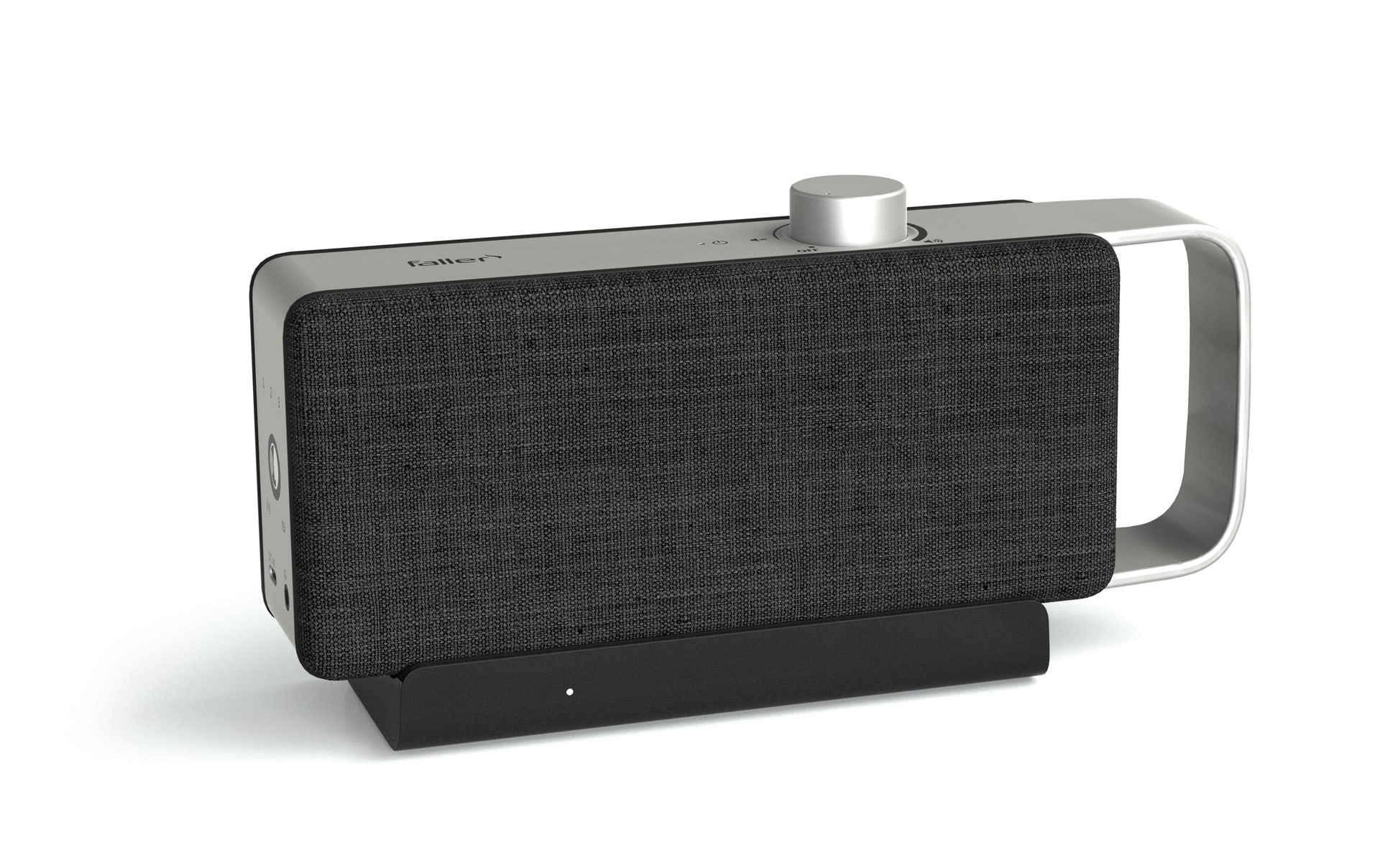
The OSKAR TV speaker from Faller Audio is a cost-effective, wireless alternative. This speaker uses a base station to transmit the signal directly to the speaker without the need for additional cables. The OSKAR TV speaker offers a user-friendly solution for anyone who wants to easily improve the sound of their TV without having to rely on cables. The wireless connection allows for flexible placement of the speaker in the room and reduces cable clutter, making it a practical option for many households.
Costs and value for money
TV speakers are usually the most cost-effective solution, as they are already integrated into the TV and do not require any additional devices or installations. Although they fulfill a basic function, they often offer only limited sound quality, which is insufficient, especially for complex soundscapes or the reproduction of dialogue. This can significantly impair the listening experience, as bass and details in the sound are often lost.
Soundbars offer a significant improvement in sound quality compared to other options. They are an ideal choice for users who want a better sound experience but don't want to invest in a complete home theater system. Soundbars cover a wide price range, from affordable entry-level models that already offer a noticeable improvement in sound quality compared to TV speakers, to premium options from brands such as Bose or Sonos. These high-quality models offer advanced technologies such as Dolby Atmos, which enable a wider soundstage and a more intense, immersive experience. They not only improve bass reproduction, but also the clarity of dialogue, delivering a more precise sound reproduction overall.
For users on a limited budget, there are also simpler soundbars available that still offer a noticeable improvement over built-in TV speakers and significantly enhance the overall viewing experience. Many soundbars are characterized by their easy integration, user-friendly operation, and durability, making them a worthwhile investment for almost any setup.
Decision-making aid: When to choose TV speakers, when to choose a soundbar?
For many users, the decision between built-in TV speakers and an external audio solution such as a soundbar or other speaker system is an easy one if the focus is on significantly improving speech intelligibility and overall sound quality. Even if the goal is not to create an elaborate home theater system, soundbars or similar systems offer a significant increase in audio performance compared to the often weak and difficult-to-understand speakers built into televisions.
A key advantage of soundbars is their ability to improve the clarity of dialogue. Many users have difficulty understanding speech at lower volumes or, above all, in complex soundscapes such as action movies or music. In such cases, soundbars help to highlight voices while minimizing distracting background noise. This improvement is also of considerable benefit in series and news programs, as dialogue is reproduced more clearly and naturally.
Soundbars are also an ideal solution for smaller rooms where space is limited. They are compact and can be easily positioned under or in front of the TV without cluttering up the room. They significantly enhance the sound, so that it no longer seems flat and lifeless. Even if you don't need a state-of-the-art, expensive audio system, a soundbar or similar solution offers a noticeable improvement in the listening experience.
For the majority of users who want to improve their TV audio quality in a simple and cost-effective way without needing complex systems or a large budget, soundbars and additional speakers are a worthwhile investment. Factors such as room size, budget, and individual requirements influence the choice, but for many, a simple soundbar or wireless speaker is an excellent choice for a significantly better TV experience.
Further articles

Healthy candy alternatives for seniors
For many people, craving sweets is part of everyday life. However, traditional sweets often contain large amounts of sugar and provide

Cooking together in old age
As we get older, our everyday lives change in many ways. The children have left home, our partner may be

Protein-rich nutrition in old age
As we age, our bodies change in many ways, and nutrition plays a crucial role in our health.