HÖRST
Inner ear – Structure and function of the hearing organ
August 8, 2025
6 minutes reading time
OSKAR
Portable TV voice amplifier
Advertisement
Table of contents
The inner ear plays a crucial role in our hearing and sense of balance. It receives sound waves, converts them into electrical impulses, and enables us to perceive the world around us acoustically. But the inner ear is not only responsible for hearing—it also helps us maintain our balance. In this article, you will learn everything you need to know about the structure and function of the inner ear, including the roles of the hair cells, the cochlea, and other important structures.
What is the inner ear and why is it important?
The inner ear is the innermost part of the human ear and is responsible for processing sound waves and maintaining balance. Without the inner ear, we would be unable to hear sounds or determine the position of our body in space. It is an extremely complex structure consisting of several interconnected components, including the cochlea, the semicircular canals, and the vestibular system.
The inner ear's job is to turn sound waves that come into the ear through the outer and middle ear into electrical signals. These signals go through the auditory nerve to the brain, which then figures out what they mean. So, the inner ear is super important for our hearing. It's also key for knowing where our body is and how it's moving. The balance organ in the inner ear enables us to maintain our balance and orientation in space.
The structure of the inner ear: What is inside?
The inner ear consists of several essential structures that work together to enable us to hear and perceive balance.
The cochlea, also known as the auditory cochlea, is one of the most important components of the inner ear. It is a spiral-shaped structure that is responsible for converting sound waves into electrical impulses. These impulses are transmitted via the auditory nerve to the brain, where they are interpreted as sounds. Inside the cochlea are hair cells, which are responsible for converting the mechanical vibrations generated by sound waves into electrical signals.
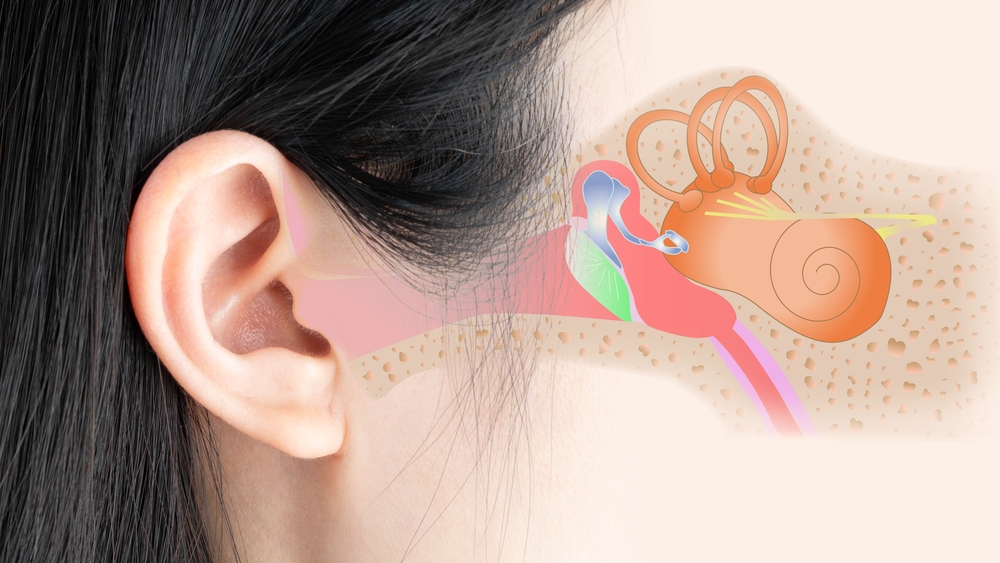
The vestibular system consists of the semicircular canals, the saccule, and the utricle, which are responsible for perceiving movement and maintaining balance. These structures register rotational movements, linear accelerations, and gravity, which helps us understand our body position in space.
The inner ear is filled with fluids such as perilymph and endolymph, which are present in the cochlea and semicircular canals and transmit sound waves and movements. These fluids play an important role in the transmission of vibrations and the perception of movement.
The function of the inner ear in the hearing process
Sound waves that hit the eardrum through the ear canal and middle ear are processed in the inner ear. The eardrum vibrates, triggering a chain reaction in the middle ear. The ossicles in the middle ear transmit the vibrations to the oval window, through which the movements reach the inner ear.
There, the cochlea converts the vibrations of the fluid into movement, which stimulates the hair cells. These hair cells convert the mechanical vibrations into electrical impulses, which are sent to the brain via the auditory nerve. The brain interprets these impulses as sounds.
The inner ear is fascinatingly complex and enables us to hear a wide range of sounds from our environment—from low tones to high frequencies. This conversion of sound waves into electrical signals is the crucial step in transmitting acoustic information to the brain.
The role of the inner ear in the balance system
The inner ear is not only responsible for hearing, but also plays a central role in maintaining balance. The vestibular system consists of the semicircular canals, which are responsible for perceiving rotational movements, and the saccule and utricle, which register linear movements and gravity. These structures work together to give us a precise perception of our body position and movement.
The perilymph and endolymph present in the semicircular canals and cochlea are crucial for the functioning of the vestibular system. When the head or body is in motion, these fluids shift and stimulate the sensory cells, which register the movement and transmit it to the brain.
Thanks to the vestibular system, we are able to monitor our posture and movement in space. This helps us maintain balance and move around in different environments without difficulty.
Diseases of the inner ear and their effects on hearing and balance
The inner ear can be affected by various disorders that impair hearing and balance. One of the most common causes of hearing problems is hearing loss, which can be caused by damage to the hair cells in the cochlea or to the structures of the inner ear. This can be due to aging, exposure to noise, or genetic factors. Another common condition that affects hearing is tinnitus, in which sufferers constantly perceive noises such as whistling or hissing that do not originate from external sound sources. Disorders of the vestibular system can lead to dizziness or vertigo, which can cause significant impairment in daily life. Ménière's disease is a disorder of the inner ear that causes recurrent episodes of vertigo, hearing loss, and tinnitus. This disorder affects the function of the inner ear and leads to serious problems with balance and hearing.
Otosclerosis is another condition in which the ossicles in the middle ear harden and impair sound transmission. This condition can lead to hearing loss without affecting the inner ear itself.

Treatment options for inner ear disorders
For many inner ear disorders, various treatments can help alleviate symptoms or improve hearing. Hearing aids are a common solution for people with hearing loss, as they amplify sounds and make hearing easier. For more severe cases of hearing loss, cochlear implants can be used to take over the function of the defective hair cells in the inner ear and connect to the auditory nerve. For Meniere's disease and other inner ear disorders, medication may be prescribed to control symptoms. These medications help reduce the frequency of vertigo attacks and alleviate the symptoms of tinnitus.
Adjusting hearing aids is also important, as a patient's hearing needs may change over time. Regular checkups with an ENT doctor help to adjust the devices and ensure that the patient receives the best possible support.
Further articles

Healthy candy alternatives for seniors
For many people, craving sweets is part of everyday life. However, traditional sweets often contain large amounts of sugar and provide

Cooking together in old age
As we get older, our everyday lives change in many ways. The children have left home, our partner may be

Protein-rich nutrition in old age
As we age, our bodies change in many ways, and nutrition plays a crucial role in our health.