HÖRST
perfect pitch
August 7, 2025
5 minutes reading time

OSKAR
Portable TV voice amplifier
Advertisement
Table of contents
Some call it a curse, others a blessing: perfect pitch. Famous composers Beethoven, Mozart, and Bach are said to have had it, but rock legends Jimi Hendrix and Michael Jackson are also rumored to have possessed this ability to correctly identify or reproduce notes without a reference tone.
In this article, we want to get to the bottom of this phenomenon and clarify what absolute pitch is all about.
What is perfect pitch?
Perfect pitch is also known as pitch memory. It is an extraordinary and rare ability that allows people to accurately identify a tone or note without having heard a reference tone beforehand.
People with perfect pitch are therefore able to recognize a musical note that is played without any other notes or tones having been played beforehand, only the note in question. Some people can even sing these notes off the cuff.
It is estimated that less than 0.01 percent of people worldwide have perfect pitch.
Absolute vs. relative pitch
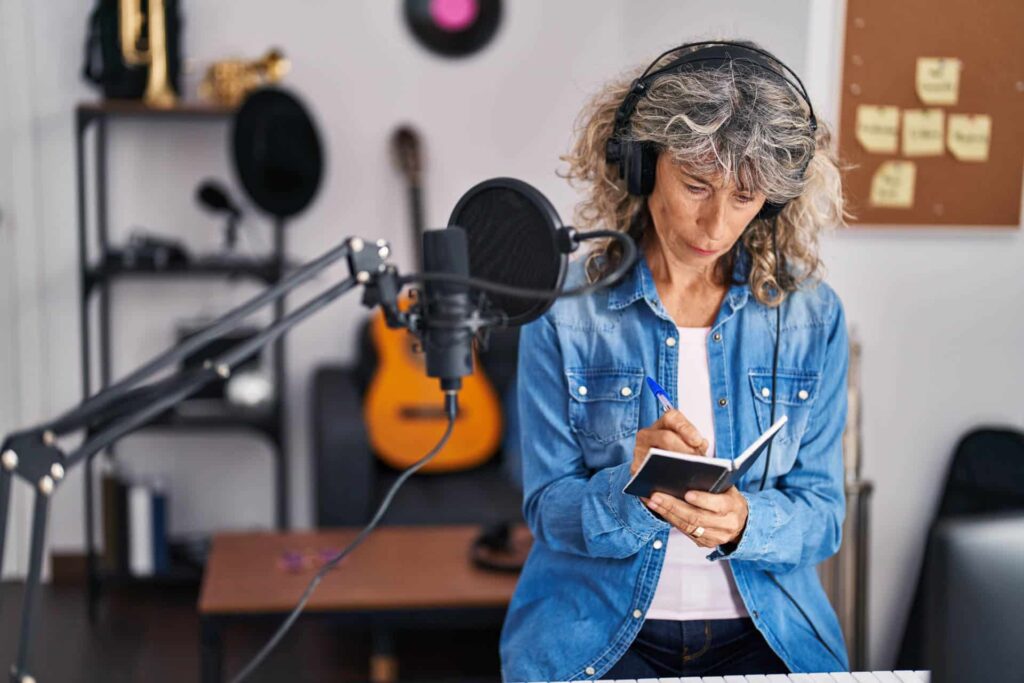
People with perfect pitch can reproduce a note exactly without having heard it before. So if you ask such a person to sing an F, for example, they will be able to do so without having heard an F or any other note immediately beforehand.
People with relative pitch can only do this with the help of a reference tone. If, for example, you play an F for them, they are able to derive other tones from it, i.e., sing a G or an A, etc.
Why do some people have perfect pitch?
Research has not yet been able to fully answer the question of why some people have perfect pitch. There is still insufficient scientific evidence for the neural mechanisms underlying this phenomenon.
However, it is assumed that people with perfect pitch use larger areas of the auditory center, also known as the "auditory cortex," when listening than people without perfect pitch. This is the area of the brain responsible for processing acoustic stimuli.
The ability appears to be hereditary. Studies have shown that genetic predisposition plays a role in perfect pitch.
Can perfect pitch be trained?
Until a few years ago, researchers were certain that perfect pitch was an exclusively innate ability. However, this finding has since been refuted. Instead, it has been discovered that pitch memory can actually be learned, but only by some children up to the age of 6.
There is therefore no such thing as perfect pitch training for adults. Instead, early musical education and intensive training can lead to young children consciously or unconsciously acquiring the ability to hear perfect pitch.
How many people have perfect pitch?
As already mentioned, only about 0.01 percent of people worldwide have perfect pitch. That's about 10 out of 100,000 people – probably fewer. However, there are regions in the world, for example in Asia, where the rate is higher. The reason for this is probably the respective native language. This is because there are so-called tonal languages in which different intonation, i.e., the pitch, is used to distinguish between meanings.
The pitch of sounds can therefore change the meaning of different words and sentences. These languages include Mandarin Chinese, one of the languages with the most native speakers worldwide. Since native languages are usually learned in early childhood, early training of the ear to recognize different pitches in tonal languages seems to increase the chance of developing perfect pitch.
Perfect pitch: advantages and disadvantages
While perfect pitch is a blessing for some people, it is a great burden for others.
Perfect pitch can offer several advantages, particularly for musicians. For example, they are able to tune their instruments without a tuner. Singers with perfect pitch can also sing songs in the correct pitch without instrumental accompaniment.
On the other hand, this ability can be a major disadvantage: many people with perfect pitch immediately hear when an instrument is out of tune. What other people would not even notice can cause them real stress. The same applies to singers with perfect pitch in a choir, who immediately notice any "mistakes" in pitch, even though the choir actually sounds harmonious together.
Which famous musicians have perfect pitch?
In the world of music in particular, there have been and still are a number of famous personalities who have perfect pitch or who are at least credited with having it. These include:
- Johann Sebastian Bach (German composer and musician, 1685–1750)
- Ludwig van Beethoven (German composer and pianist, 1770–1827)
- Frédéric Chopin (Polish composer and pianist, 1810–1849)
- Wolfgang Amadeus Mozart (Austrian composer and musician, 1756–1791)
- Ray Charles (American soul musician and singer, 1930–2004)
- Mariah Carey (American pop musician and singer, 1969)
- Celine Dion (Canadian pop singer, 1968)
- Ella Fitzgerald (American jazz musician and singer, 1917–1996)
- Falco (Austrian musician, 1957–1998)
- Glenn Gould (Canadian pianist, 1932–1982)
- Jimi Hendrix (American rock musician and singer, 1942–1970)
- Whitney Houston (American R&B musician and singer, 1963–2012)
- Michael Jackson (American pop musician and singer, 1958–2009)
- Charlie Puth (American pop musician and singer, born 1991)
- Brian Wilson (American musician and singer, The Beach Boys, 1942)
- Stevie Wonder (American soul and pop singer, 1050)
Further articles

Healthy candy alternatives for seniors
For many people, craving sweets is part of everyday life. However, traditional sweets often contain large amounts of sugar and provide

Cooking together in old age
As we get older, our everyday lives change in many ways. The children have left home, our partner may be

Protein-rich nutrition in old age
As we age, our bodies change in many ways, and nutrition plays a crucial role in our health.