HÖRST
Learn sign language
August 8, 2025
8 minutes reading time

OSKAR
Portable TV voice amplifier
Advertisement
Table of contents
More than 350 million people worldwide are severely hearing impaired or deaf. In Germany, the figure is approximately 80,000. If you include all people with hearing loss, the number is estimated to be more than one billion.
Sign language exists so that deaf and hard-of-hearing people can communicate with each other and with the hearing world. Below, you can learn more about this language, its history, regional differences, and how it works. We also have a few interesting tips for anyone who wants to learn sign language.
What is sign language?
Sign language is a visual language. It uses signs, i.e. movements of the body, especially the arms and hands, gestures and facial expressions, body posture and mouth shape, to convey information, sentences and words, and to express feelings and imitations. It is often referred to colloquially as "sign language."
Like any other natural language, it has its own grammar and rules. Individual words also have individual sign language signs.
There are approximately 300 different sign languages worldwide.
Who needs sign language?
Sign language helps deaf people communicate with each other. But relatives, family, and friends also benefit from knowing sign language, as it enables them to communicate with their loved ones. Sign language is particularly important for parents of deaf children, or children of deaf parents, as it helps build an emotional bond, better supports the child's development, etc.
In addition, knowledge of sign language is essential in numerous public areas and occupational groups. These include, for example, educators and teachers, sign language interpreters, healthcare professionals such as doctors and nurses, and many other groups of people who live, work, and communicate with deaf people.
The history of sign language
The history of sign language dates back to ancient times. The works of the Greek philosopher Plato and the Roman bishop Augustine of Hippo contain the first references to deaf people using sign language.
Over the centuries, various sign languages and finger alphabets developed around the world—originally in monasteries, so that monks could communicate despite their vow of silence. These finger alphabets were also used to teach the first deaf people in the 17th century.
After the first school for deaf children was founded in France in the 18th century, where teaching was done using sign language, sign language was banned again in Europe at the end of the 19th century at the so-called Milan Congress. Instead, pupils were to be taught to speak.
Hard to believe: this ban remained in place in some cases until the 1980s. In France, sign language was still banned in schools for deaf children until 1991. Fortunately, sign language has now established itself as a fully-fledged language.
At an international conference on the education and training of deaf people held in Canada in 2010, an official apology was issued for the ban on the Milan Conference and the consequences that this ban had for deaf people were officially recognized.
Is sign language the same in all countries?
There is no single sign language, but rather around 300 different sign languages around the world. These different languages differ, just like the spoken languages of each language community, in their vocabulary, grammar, and syntax, i.e., sentence structure. They are in turn divided into different sign language families. In addition to German Sign Language (DGS), there is also British Sign Language (BSL) in the United Kingdom, American Sign Language (ASL) in the USA, and Japanese Sign Language (JSL) in Japan, for example. Other sign language families include Spanish sign languages, Arabic sign languages, and Chinese sign languages.

Although there is also a sign language called International Sign, i.e., an international form, this is a so-called pidgin language, meaning a reduced language. It is used by deaf people to communicate at international meetings.
German Sign Language
German Sign Language (DGS) is used by around 250,000 deaf and hard-of-hearing people in Germany, Belgium, and Luxembourg, and for some it is even their first language.
The vocabulary of German Sign Language comprises approximately 19,000 words, which differ from spoken language. For example, there are no articles such as "der," "die," or "das" in DGS. There are also no verb tenses. These are expressed in DGS using temporal adverbs and contextual information, for example with specific signs for "yesterday," "today," or "tomorrow."
According to the Disability Equality Act (BGG), § 6.1, German Sign Language is "recognized as an independent language." Source: https://www.gesetze-im-internet.de/bgg/__6.html
Regional differences in the DGS
Germany does not have a standardized sign language. Just like in spoken language, there are regional differences in German sign language in the sense of dialects, as well as a youth language. The grammar is the same, but the signs differ or have different meanings.
This means that communication problems can quickly arise in sign language too, for example when someone from Bavaria and someone from Saxony are talking to each other.
What is the German finger alphabet?
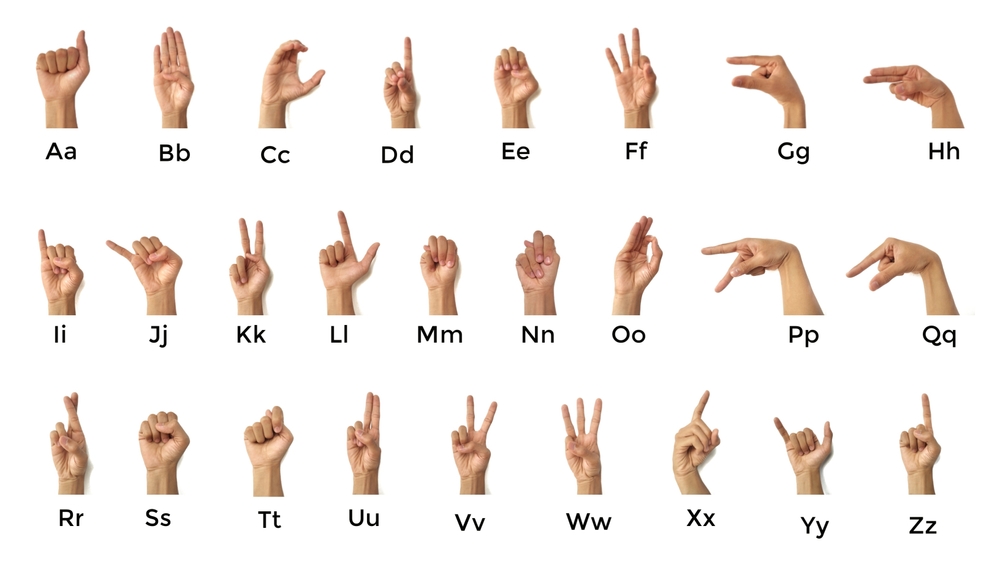
The German finger alphabet is not the same as German sign language. Rather, it is part of it, as it is used in sign language communication to spell out individual words, such as proper nouns or foreign words that do not have their own signs. For this reason, each letter of the alphabet and the numbers from 1 to 10 are assigned their own sign. Umlauts, "ß" and "sch" also have their own signs.
The German finger alphabet is a one-handed finger alphabet, which means that each hand sign can be formed with just one hand. The letters are usually displayed in front of the chest with the right hand, or with the left hand for left-handed people.
Where can you learn sign language?
Those who wish to learn German Sign Language will find various courses offered by different institutions. These include, for example
- Deaf associations or federations
- Schools for the deaf and sign language schools
- adult education centers (VHS)
- Universities and technical colleges
Here you will find sign language courses for beginners and advanced learners, study groups, and parent-child courses. Further information is usually available on the respective website.
In addition, there are various online sign language courses and platforms, numerous instructional videos, sign language dictionaries, and sign language apps available on the internet that can support or facilitate the learning of sign language.
It can also be helpful for learners to watch various television programs with additional sign language interpretation. You can find out more about this below.
Sign language on television
Information should be equally accessible to everyone. However, deaf people often face particular difficulties in this regard, for example when watching television.
More and more television stations are therefore now supporting "accessible television" and offering accessible programming, for example for news programs.
In addition to subtitles and clear language settings for people with hearing impairments, public broadcasters in particular offer sign language translations: visual representations of the spoken content by sign language interpreters, which are recorded or translated live into sign language depending on the program or broadcast. The interpreters are usually shown in a small window at the edge of the screen, while the program is shown on the large screen.
Sign language apps
Thanks to technological advances in recent years, there are now various apps available that can make life easier for people who are hard of hearing or deaf. These include, for example, volume and hearing amplifier apps, transcription apps, and sign language apps. Sign language apps, for example, help with learning or translating sign language.
Learning sign language: Tips for relatives of deaf people
If you want to learn a new language, you should be prepared to be patient and persistent. This also applies to sign language. However, the following tips may help you:
- Learn from professionals: Sign language courses at adult education centers or deaf associations, as well as professional online courses, are the best way to learn sign language.
- Use supporting tools: With the help of dictionaries, videos, and apps, you can further support your learning success or even teach yourself sign language.
- Speak: The best way to learn a language is to speak it. The same applies to sign language: the more you use it, the better and more confident you will become.
- Stay on the ball: Learning a new language can be tedious and involve a lot of studying. But if you stay on the ball, you will gradually notice progress. It feels good.
- Television with sign language interpretation: Why not watch the news or a sporting event with sign language interpretation? You can learn a lot and expand your vocabulary.
Further articles

Healthy candy alternatives for seniors
For many people, craving sweets is part of everyday life. However, traditional sweets often contain large amounts of sugar and provide

Cooking together in old age
As we get older, our everyday lives change in many ways. The children have left home, our partner may be

Protein-rich nutrition in old age
As we age, our bodies change in many ways, and nutrition plays a crucial role in our health.