HÖRST
Playing a musical instrument with hearing loss
January 9, 2026
11 minutes reading time
OSKAR
Portable TV voice amplifier
Advertisement
Table of contents
Music touches people in many ways and is an important part of life for many. But what happens when hearing deteriorates? The good news is that hearing loss does not necessarily mean the end of musical activity. Below, we show you the options available for playing a musical instrument even with hearing loss, which instruments are particularly suitable, and which technical aids can help.
The most important information in brief
- In many cases, it is still possible to play music even with hearing loss.
- Instruments with fixed pitches, such as the piano or guitar, can offer advantages for people with hearing loss.
- Rhythm and percussion instruments produce vibrations that can also be felt physically.
- Some modern hearing aids have special music programs.
- Visual aids such as tuners and metronomes can support music-making.
- Protecting your remaining hearing should be taken into account when playing music.
- An individual consultation with an ENT doctor or hearing care professional is recommended.
Why playing music is still possible even with hearing loss
The idea that hearing loss and active music-making are incompatible is persistent, but it does not correspond to reality. Music is not perceived exclusively through hearing, and there are numerous ways to continue musical activity even with limited hearing. The following sections explain why music-making can still be possible and what role the type of hearing loss plays in this.
Hearing loss does not mean the end of music
Historical and current examples show that even people with significant hearing impairments can be musically active. The connection to music goes beyond mere hearing and also encompasses physical sensations, memories, and emotional aspects. Many people with hearing loss report that music continues to play an important role for them, even if the way they perceive it has changed. The brain can partially fill in acoustic gaps with stored memories of familiar melodies and sound patterns. In addition, certain frequency ranges remain intact in many forms of hearing loss, so that parts of the sound spectrum can still be perceived. If you would like to learn more about living with hearing loss, you can find further information in our guide.
How different types of hearing loss affect music-making
Hearing loss is not a uniform diagnosis, but encompasses a broad spectrum from mild hearing impairment to severe hearing loss. The affected frequency ranges can also vary. In the case of high-frequency hearing loss, which often occurs with age, low frequencies can often still be heard well, while high frequencies are more difficult to hear. This influences which instruments are particularly suitable and which adjustments may be helpful. Every person experiences sounds differently, which is why there are no one-size-fits-all solutions. A professional assessment by an ENT doctor or hearing care professional can help to understand individual requirements and develop suitable strategies.
Which instruments may be suitable for hearing loss
The choice of instrument can play an important role in hearing loss. Certain types of instruments offer features that can make it easier to play music with impaired hearing. The following sections provide an overview of different instrument groups and their respective characteristics.
Keyboard instruments and their advantages
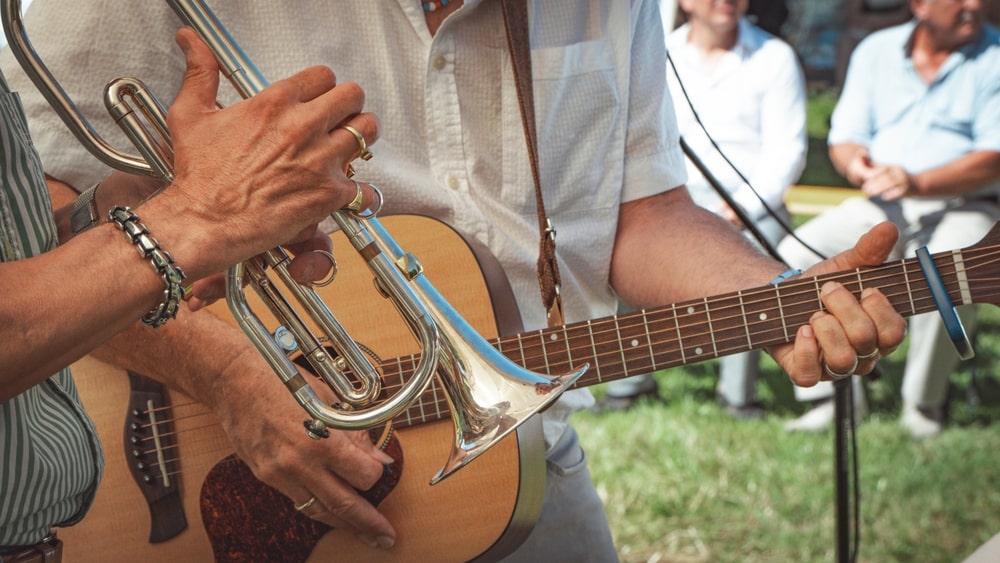
Piano, keyboard, and organ are among the instruments often recommended for people with hearing loss. The main advantage is that the pitch of these instruments is mechanically fixed. Unlike string instruments, the intonation does not have to be controlled and corrected by ear. In addition, keyboard instruments offer distinct tactile feedback. The vibrations of the piano's soundboard can be felt through the fingertips and, to some extent, on the body. Electronic keyboards also allow the volume to be adjusted and can be used with headphones, which can make it easier to perceive individual sounds. The guitar, with its fixed frets, also offers a predetermined pitch and produces vibrations that can be felt on the body.
Rhythm and percussion instruments
Drums, percussion, and other rhythm instruments produce strong vibrations that can be not only heard but also physically felt. This makes them particularly accessible to people with hearing loss. Low frequencies, such as those produced by a bass drum, often remain perceptible longer than high frequencies in many types of hearing loss. In addition, the rhythmic component of music is often easier to grasp than melodic subtleties. Playing percussion instruments allows you to focus on the rhythm and perceive it through your hands, feet, or entire body. The electric bass, with its low frequencies, can also be a suitable choice for people with high-frequency hearing loss.
Challenges with string and wind instruments
String instruments such as the violin or cello require precise control of intonation, as the pitch is determined by the position of the fingers on the fingerboard. Without acoustic feedback, this can be difficult, but it is not impossible. Years of experience and well-developed muscle memory can help you find the right fingerings. With wind instruments, the so-called occlusion effect can occur when the ear canal is closed by a hearing aid earpiece. In this case, body noises such as your own breathing are amplified via bone conduction, which can be perceived as disturbing. Consulting with a hearing care professional can be helpful here. In principle, it is possible to play these instruments if you are motivated and make the appropriate adjustments.
Technical aids for making music
Modern technology offers various ways to support music-making for people with hearing loss. From special settings in hearing aids to supplementary devices, there are a number of different approaches. The following sections present some of these options.
Hearing aids with music program
Standard hearing aids are usually optimized for understanding speech. This involves amplifying certain frequency ranges and suppressing background noise. However, these settings can be detrimental to listening to music and playing music, as they can distort the sound. Many modern hearing aids therefore offer special music programs that work differently. In these programs, noise suppression is often deactivated and the dynamics are less compressed. The aim is to achieve the most natural, unaltered sound possible. It is advisable to have an open discussion with your hearing care professional about your musical activities in order to adjust the settings accordingly. Fine-tuning may take some time and patience until the result is satisfactory.
Other supporting technologies
In addition to hearing aids, there are other technical aids that can support music-making. Bluetooth streamers enable the audio signal to be transmitted directly from the instrument or a sound system to the hearing aid. This reduces ambient noise and allows the sound to reach the ear more directly. Cochlear implants may be considered for severe hearing loss, although music perception with a CI may be unfamiliar at first and require a period of adjustment. Some people report good results when listening to music and playing music with a CI, although individual perception can vary greatly. The decision to have such an implant should be made in close consultation with specialists. Apps for adjusting frequency responses and volumes can allow you to adjust the settings yourself depending on the situation.
Alternative ways of perceiving music while playing
Music is not perceived exclusively through hearing. The body can feel vibrations, and visual aids can supplement acoustic information. These alternative modes of perception play an important role in making music with hearing loss.
Feeling music through vibrations
Many instruments produce vibrations that can be felt on the body. With the cello, for example, the resonance of the body is transmitted to the player's chest. With the piano, vibrations can be felt through the fingertips and the soles of the feet on the pedal. Some musicians deliberately play barefoot in order to feel the rhythm through the floor. Touching speakers or amplifiers can also help to physically perceive low frequencies. This vibrotactile perception is particularly helpful with bass-heavy and rhythmic music. Although it does not completely replace hearing, it can be a complementary aid to orientation in musical events.
Visual aids and orientation
The eye can play an important supporting role when making music. Electronic tuners visually indicate whether a note is at the correct pitch. This is particularly helpful for instruments without a fixed pitch. Visual metronomes, which indicate the beat with flashes of light, can support rhythmic timing. Apps for visualizing pitches make acoustic information visible. In an ensemble, eye contact with fellow musicians and the conductor is particularly important. Carefully observing movements and cues can supplement acoustic reference points. A sound knowledge of music theory and reading music can also help to deepen musical understanding independently of acoustic perception.
Practical tips for everyday music-making
In addition to choosing an instrument and technical equipment, organizational and practical aspects also play a role. The following sections provide tips for playing music in a group and protecting your remaining hearing.
In the ensemble and during rehearsals
Playing music together in a band, choir, or orchestra poses particular challenges. Open communication about your hearing loss can help your fellow musicians be considerate and avoid misunderstandings. During rehearsals, it is helpful if musicians do not play while discussions are taking place, so that what is being said can be heard more clearly. Positioning in the room can also be important. If you can see where the conductor or other musicians are, it is easier to orient yourself. For bands, in-ear monitoring can be a solution, where an individually mixed signal is received directly through earphones. This makes it possible to hear your own instrument and important reference signals more clearly. If you are interested in aids and technology for the hard of hearing, you can find more information in our magazine.
Protection of remaining hearing
For people with existing hearing loss, protecting their remaining hearing is particularly important. Playing music can involve high volumes, which can put additional strain on the ears. Special hearing protection for musicians is designed to reduce volume without significantly distorting the sound. Such hearing protection solutions with linear filters reduce the sound level evenly across all frequencies. Unlike simple foam earplugs, which often make the sound seem muffled, the music remains more natural. During rehearsals and performances, attention should be paid to the volume and regular breaks should be planned. Those who already suffer from tinnitus should be particularly careful and, if necessary, seek professional advice to prevent further deterioration.
Frequently asked questions (FAQ)
Which instrument is best suited for beginners with hearing loss?
Instruments with fixed pitches, such as the piano, keyboard, or guitar, are often easier to learn because the intonation is mechanically predetermined. Rhythm instruments are also well suited because they produce strong vibrations that can be felt physically.
Do I have to remove my hearing aid when playing music?
Not usually. However, it may be useful to use a special music program that compresses the sound less than the speech program. It is best to talk to your hearing care professional to find the optimal settings.
Can playing music further impair hearing?
At very high volumes, there is a risk to your remaining hearing. It is important to pay attention to the volume and, if necessary, wear special hearing protection for musicians, which attenuates the sound level but largely preserves the sound character.
How can I keep time despite hearing loss?
Visual metronomes that indicate the beat with light signals, or the noticeable tapping of the foot, can help. In a group, eye contact with fellow musicians or the conductor is essential to stay rhythmically in sync.
Further articles

Healthy candy alternatives for seniors
For many people, craving sweets is part of everyday life. However, traditional sweets often contain large amounts of sugar and provide

Cooking together in old age
As we get older, our everyday lives change in many ways. The children have left home, our partner may be

Protein-rich nutrition in old age
As we age, our bodies change in many ways, and nutrition plays a crucial role in our health.