HÖRST
Barrier-free living in old age
October 1, 2025
9 minutes reading time
OSKAR
Portable TV voice amplifier
Advertisement
Table of contents
For many people, their own home is the most important place for living independently in old age. However, as we get older, everyday obstacles such as steps, narrow door frames, or slippery floors can become challenges. Well-planned home modifications create the conditions for a safe and comfortable life within the familiar four walls. This is not just a matter of removing barriers, but of creating a living environment that maintains mobility, safety, and quality of life in the long term.
The most important information in brief
- Barrier-free living complies with defined DIN standards and enables independent living in old age.
- Key areas for renovation: entrance areas, bathrooms, kitchen, living and sleeping areas
- Important minimum dimensions: Door widths from 80 cm, movement areas of 120 x 120 cm
- Simple measures can already bring about major improvements
- Early planning prevents costly adjustments later on.
- Professional advice helps with optimal implementation
Basics of accessible home adaptation
Barrier-free living means that living spaces can be used by people with various physical limitations. This includes not only mobility limitations, but also age-related hearing loss and visual impairments. The two-senses principle states that important information should be perceptible through at least two senses.
DIN standard 18040-2 defines clear standards for barrier-free construction. These technical requirements ensure that conversion measures are truly functional and provide long-term benefits. Forward-looking planning can prevent small limitations from becoming major obstacles later on.
Barrier-free design of entrance areas
Create accessible paths and entrances
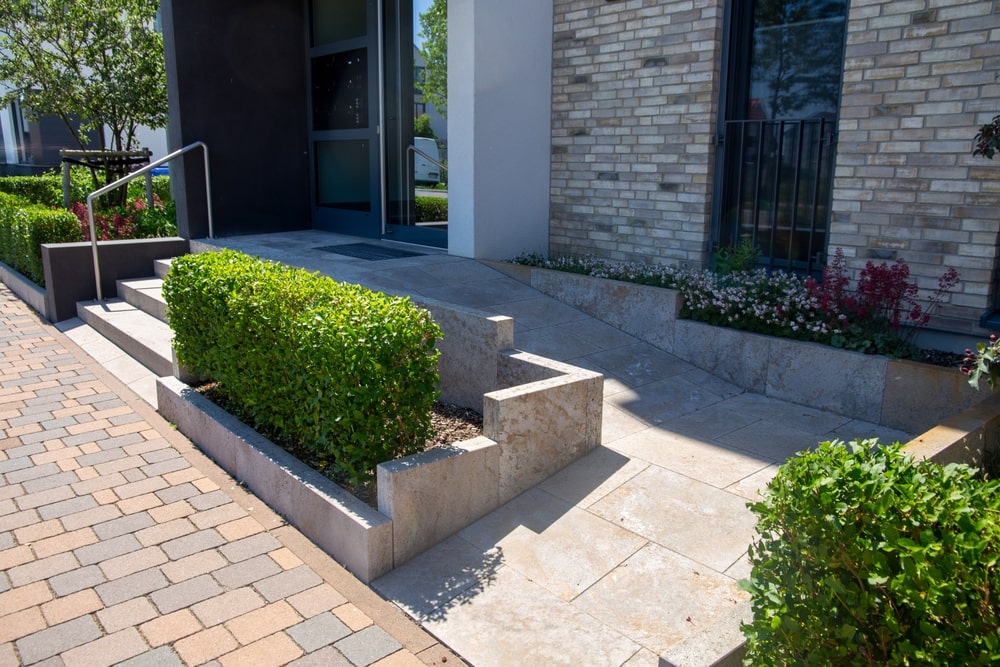
The path to the front door should be at least 120 cm wide and free of steps. Where differences in height are unavoidable, ramps can be a solution, but the gradient should not exceed 6 percent. Handrails on both sides of the ramp provide additional safety.
The front door should have a clear passage width of at least 90 cm. Door thresholds should be avoided if possible or limited to a maximum of 2 cm. A covered entrance area protects against the weather and provides space to open the door safely.
Optimize lighting and orientation
Adequate lighting in the entrance area is crucial for safety. Motion detectors provide automatic lighting without having to search for switches. High-contrast design of steps, door frames, and other important elements facilitates orientation.
House numbers and doorbell signs should be clearly legible and adequately lit. Tactile elements can make it easier for people with visual impairments to find their way around.
The accessible bathroom
Safety through careful planning
The bathroom is considered one of the most accident-prone areas in the home. A floor-level shower eliminates tripping hazards and allows easy access even with walking aids or a wheelchair. The shower area should be at least 120 x 120 cm; 150 x 150 cm is required for wheelchair access.
Non-slip flooring is essential throughout the bathroom, not just in the shower. The R10 slip resistance class is suitable for barefoot areas, while R11 offers additional safety. When choosing colors, ensure there is sufficient contrast to facilitate orientation.
Functional features for greater comfort
Handrails and support bars in strategically important locations significantly increase safety, especially for people who live alone in old age. These should be taken into account during the planning stage, as retrofitting them is often more complicated. Foldable support handles offer flexibility and can be stowed away to save space when not in use.
A wheelchair-accessible washbasin can be used while seated and also offers more legroom for standing users. The faucet should be operable with one hand, ideally as a single-lever mixer or touchless variant.
The toilet should be installed at a height of 46-48 cm. A toilet with an integrated flush and bidet function can facilitate hygiene. Sufficient space of at least 120 cm in front of the toilet is important for independent use.
The accessible kitchen
Creating ergonomic workplaces
A barrier-free kitchen is characterized by ergonomic solutions that make everyday tasks easier. Wheelchair-accessible work surfaces at a height of 80-85 cm allow users to work while seated. Height-adjustable work surfaces offer even more flexibility for different users.
Pull-out drawers are preferable to conventional doors as they provide a better overview and easier access to the contents. Full extension drawers with a soft-close function reduce the effort required to close them.
Intelligently plan devices and equipment
Kitchen appliances should be installed at a comfortable height. An oven at eye level makes it easier to use and avoids bending down. Side-by-side refrigerators with freezer compartments next to each other are often more practical than stacked versions.
The sink should not be too deep and should have a one-handed faucet. A dishwasher with a raised installation reduces the need to bend down when loading and unloading. Induction cooktops with touch controls are often easier to use than conventional models.
Barrier-free living and sleeping areas
Freedom of movement and functionality
In living rooms and bedrooms, there should be sufficient space between furniture. A passageway of at least 120 cm allows for easy use with walking aids. For wheelchair users, 150 cm is required.
The bed should be accessible from three sides and have a height of 45-50 cm to make it easier to get in and out. Height-adjustable beds offer additional comfort. Bedside tables should be designed to be wheelchair accessible so that they are easy to reach even when seated.
Storage space and controls
Cabinets and shelves should be planned so that frequently used items are within reach at a height of 40-140 cm. Sliding doors are often more practical than hinged doors, as they require less space and are easier to open.
Light switches and sockets should be installed at a height of 85-105 cm. Touch-sensitive switches or remote controls can make operation even easier. Adequate lighting with glare-free lights ensures safety and comfort.
Stairs and connecting routes
Safety at all levels
Stairs often pose the greatest challenge in a barrier-free home. Handrails on both sides of the stairs provide safety and should extend beyond the first and last steps. The handrails should have a diameter of 3-4.5 cm and be easy to grip.
Contrasting step edges make it easier to find your way, especially if your eyesight is failing. Non-slip coverings or anti-slip strips can provide additional safety. Uniform, glare-free lighting throughout the staircase is essential.
Stairlifts can be an alternative if structural changes are not possible. Platform lifts are suitable for wheelchair users, while seat lifts are suitable for people with walking difficulties.
Simple measures with a big impact
Remove tripping hazards
Even simple changes can significantly improve safety. Loose electrical cables should be secured with cable ducts or cable bridges. Carpets must be laid in a non-slip manner and the edges must be firmly glued down. High-pile carpets are less suitable as they make it difficult to walk with walking aids.
Door thresholds can often be removed or replaced with flatter versions. Mobile ramps can be placed temporarily over small thresholds. Sliding doors are often more practical than hinged doors, especially in confined spaces.
Optimize lighting and visibility
Good lighting is fundamental to safety. LED lights are durable and generate little heat. Motion detectors in hallways and stairwells provide automatic lighting. Night lights can safely illuminate the way to the bathroom.
High-contrast design helps with orientation. Door frames, handrails, and step edges should stand out from the background in terms of color. Reflective elements can also improve visibility.
Technical aids and smart homes
Modern support in everyday life
Smart home systems can make everyday life much easier. Voice-controlled systems allow you to operate lights, heating, and other devices without physical effort. Automated roller shutters can be controlled via a timer or app.
Many aids for everyday life can promote independence. Home emergency call systems offer security in case of emergencies. Door intercoms with video transmission allow you to identify visitors without having to go to the door.
Communication and information
For people with hearing impairments, special aids for the hard of hearing can significantly improve their quality of life. Light bells and vibrating alarm clocks provide reliable signals. Hearing aid-compatible telephones facilitate communication.
Large, easy-to-read labels on switches and devices help those with declining eyesight. Talking devices can convey information acoustically. Tablet computers with simplified user interfaces enable access to digital services.
Planning and professional support
Plan ahead
When planning barrier-free renovations, future needs should be taken into account. What may not seem necessary today may become essential tomorrow. Preparatory installation work, such as reinforcing walls for future grab bars, is more cost-effective than retrofitting.
Turning circles for wheelchairs, the optimal height for switches and sockets (85–105 cm), and sufficient space for movement should be planned from the outset. A consistent design language ensures a harmonious overall appearance.
Take advantage of expert advice
Housing advice centers offer impartial information and support with planning. Occupational therapists can analyze individual needs and suggest suitable solutions. Collaboration with specialist tradesmen ensures professional implementation in accordance with applicable standards.
Architects with experience in barrier-free construction can provide valuable support for larger renovations. They are familiar with the technical requirements and can develop creative solutions for individual challenges.
Living and housing in old age
Maintain independence
Barrier-free living enables people to live independently and autonomously in old age. Investing in appropriate modifications pays off in terms of improved quality of life in old age and longer independence. Preventive measures are often more cost-effective than reactive adjustments after problems have already arisen.
Addressing barrier-free living at an early stage enables a conscious and well-thought-out design of the living environment. This is not just about overcoming limitations, but about creating an environment that promotes comfort, safety, and joie de vivre.
Further articles

Healthy candy alternatives for seniors
For many people, craving sweets is part of everyday life. However, traditional sweets often contain large amounts of sugar and provide

Cooking together in old age
As we get older, our everyday lives change in many ways. The children have left home, our partner may be

Protein-rich nutrition in old age
As we age, our bodies change in many ways, and nutrition plays a crucial role in our health.